Sofie's blog
  • Home
  • About Sofie
  • contact & links
  • Policy
  • Search
  • My book
  • Nordic Sustainable Architecture

"The culture of post-construction disengagement needs to change"

8/22/2013

0 Comments

 
"This culture of post-construction disengagement needs to change and the industry needs to recognise under performance". [this comment piece first appeared in AJ, June 2013]


The Architects’ Journal Bridge the Gap campaign is a timely effort to mobilise architects and the wider industry to address the under performance of so many of our buildings. 

Many architects are unaware of large disparities between new buildings’ predicted performance and their actual performance. Most architects probably do not even know what the predicted energy use is of the building they designed because modelling is outsourced to other consultants, let alone what the actual energy use turns out to be. Usually architects do not return to evaluate their buildings once they are commissioned and occupied. The majority of architects are not particularly interested in finding out about their buildings’ performance, nor do they usually get paid to do this. One reason may be that PII providers do not encourage it. Why go back to evaluate your design when you may find problems and get sued? The addition of an ‘In Use’ workstage in the new RIBA Plan of Work is a step in the right direction.  

This culture of post-construction disengagement needs to change. The industry as a whole must recognise this underperformance. The ‘design-modelling- construction- in-use’ feedback loop is invaluable because it allows us to reflect on our mistakes. This learning process – both individually and, if made public, can prevent the repetition of mistakes.

Let’s also be honest. If a building does not perform as predicted, we tend to hide this news in silence. I applaud the Bridge the Gap campaign as a way to encourage transparency and promote awareness and industry-wide learning about the performance gap. We need to get over the constant burying of underperformance in silence. 

0 Comments

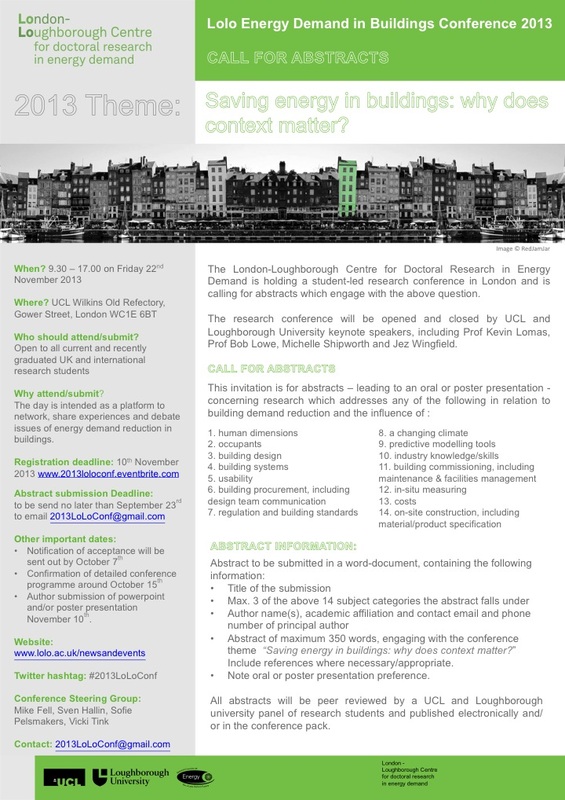
“Saving energy in buildings: why does context matter?” - LoLo Energy Demand in Buildings Conference 2013 - Nov 22nd 

8/14/2013

0 Comments

 
Following on from Bordass and Leaman's masterclass in June 2013, the London Loughborough Centre for Doctoral Research in Energy demand is bringing together research students on November 22nd 2013 to discuss "saving energy in buildings: why does context matter?". 


We are looking for poster and presentation abstracts from research students - submission deadline September 23rd. More info on flyer below and on the Lolo website. 


You can also already register for attendance (Prof Bob Lowe, Prof Kevin Lomas and Jez Wingfield are confirmed speakers) - the event is FREE to research students. 

PDF flyer for download.
Picture
0 Comments

Initial findings of the Zero Caron Hub's Design and as-Built Performance research

8/2/2013

0 Comments

 
Download the full interim report / executive summary and appendices here.

Nothing surprising so far; with the following issues identified:

  1. lack of suitable energy performance analysis tools
  2. SAP needs further work: concern about input assumptions and transparency of inputs. Further work for certain inputs required, including ventilation, thermal mass, hot water + lighting
  3. lack of communication between design team and 'energy assessor' 
  4. lack of understanding by contractor, planners about their role in building energy performance.
  5. lack of clarity and consistency on what planning requirements are needed and information required to demonstrate compliance.
  6. product and material specifications are tested according to EU norms in isolation (like thermal labs and as components) rather than in in-situ systems and this may contribute to a performance gap.
  7. limitations of U-value calculation conventions and comparison with in-situ testing methodology are an issue
  8. practice of substitution of 'or equivalent' specifications requires sufficient information on performance criteria of products or materials so that an 'equivalent' substitute is made. Often this is not the case and changes not fed back to the design team and to performance assessor.
  9. insufficient detail/drawings (or unbuildable details drawn) for the construction team to construct assemblies to achieve intended performance such as airtightness and thermal performance. No feedback from site to design team to learn lessons.
  10. limited installation/construction instructions provided by manufacturers on their materials
  11. lack of skills/knowledge on site to install systems correctly, especially ventilation systems and heat pumps
  12. priority of Building Control on health & safety and they are often sen as "quality Control', when compliance is still the responsibility of the contractor
  13. Accredited and Enhanced Construction Details are being reviewed as well as thermal bridge calculation procedures and need to be updated to reflect improved building fabric standards, buildability and robustness
  14. lack of a Competent Person Scheme for thermal bridge calculations
  15. lack of knowledge and skills to deliver building performance at all levels are a concern
In the report, a 2020 ambition was highlighted: to demonstrate that "at least 90% of all new homes meet or perform better than the 
designed energy / carbon performance".


A final report will be issued in March 2014.


0 Comments

    Author

    This is Sofie's blog; or rather a collection of musings & articles sometimes also published elsewhere. More about Sofie here.

    Archives

    May 2015
    August 2013
    July 2013
    June 2013

    Categories

    All
    Actual Energy Use
    Architect's Journal
    Bridge The Gap
    Building Performance Evaluation
    Conference
    Performance Gap
    Performance Modelling
    Post Occupancy Evaluation
    Predicted Energy Use
    Underperformance

    RSS Feed

© Sofie Pelsmakers  - Banner image credit: Pari Naderi for RIBA Role Model Project
  • Home
  • About Sofie
  • contact & links
  • Policy
  • Search
  • My book
  • Nordic Sustainable Architecture